
Identify a Coffey County Owner
The free Coffey County CAMA Parcel Search takes owner, address, parcel, legal-description, tax-unit, neighborhood, and subdivision criteria. Enter as a public user. The situs address, meaning the land's physical location, is the best first query. Save the exact owner string and full parcel number.
- Search the full property address in CAMA. For rural land, try the road or legal description.
- Open the parcel card and copy Owner's Name, APN, legal description, and deed reference.
- Ask the Register of Deeds to confirm the grantee on the newest recorded instrument.
- For an LLC, consult the Kansas business filing while keeping the deed's owner name intact.
Coffey County Ownership Sources
Three county sources can name an owner. Only the recorded deed addresses the transfer itself. CAMA suits an address-first property search, GIS adds the map layer, and the Register of Deeds holds the deed records that document each transfer.
| Source | Owner Info It Gives | Access |
|---|---|---|
| CAMA appraisal roll | Owner, mailing and situs addresses, deed reference | Free public search |
| Register of Deeds | Grantee and recorded transfer | Office request |
| Kansas business search | Public LLC filing details | Free state search |
| County GIS | Parcel shape and identifier | Public viewer |
An owner is not always an occupant. A trust can list a trustee's mailing address, an LLC may receive mail in another state, and farmland may lack a standard street number. Sample Coffey cards show MOUNDVIEW LLC and a trust string with several trustee names. Search that exact roll string first.
Read Coffey Owner Fields
A Coffey parcel card splits Owner's Name, mailing address, and property address into separate fields. Classification, acreage, value history, and deed references appear too. Keep the situs and mail fields labeled. The mail destination proves little about residence.
Rural cards may list “0 Old 50 Hwy” or “0 20th Rd.” Mail can go to another city. Copy the section-township-range text and the segmented APN when a street search fails, because those identifiers make the deed records handoff at the recorder far safer.
Confirm a Coffey County Grantee
The Coffey County Register of Deeds confirms ownership. No public grantor-grantee portal or deed-image index exists online. Contact the office with the exact owner string, APN, legal description, and the CAMA book/page or document reference.
A deed can be newer than the appraisal roll. The county publishes no closing-to-roll service time. A database update timestamp shows an active refresh, not that every sale has posted to the roll.
Companies and Trusts Own Property
Never swap a trust string for a guessed person. The Kansas Business Entity Search may surface public LLC filing details, but it cannot alter the deed. Trust names can carry punctuation and several trustees. Begin with the exact CAMA form.
When an owner has died, probate, a recorded death certificate, or an estate deed can explain a mismatched name. That records trail is lawful but does not prove an heir holds title.
Inspect a Coffey Parcel Card
A sample Coffey parcel detail shows owner, mailing, situs, deed, and value fields together.
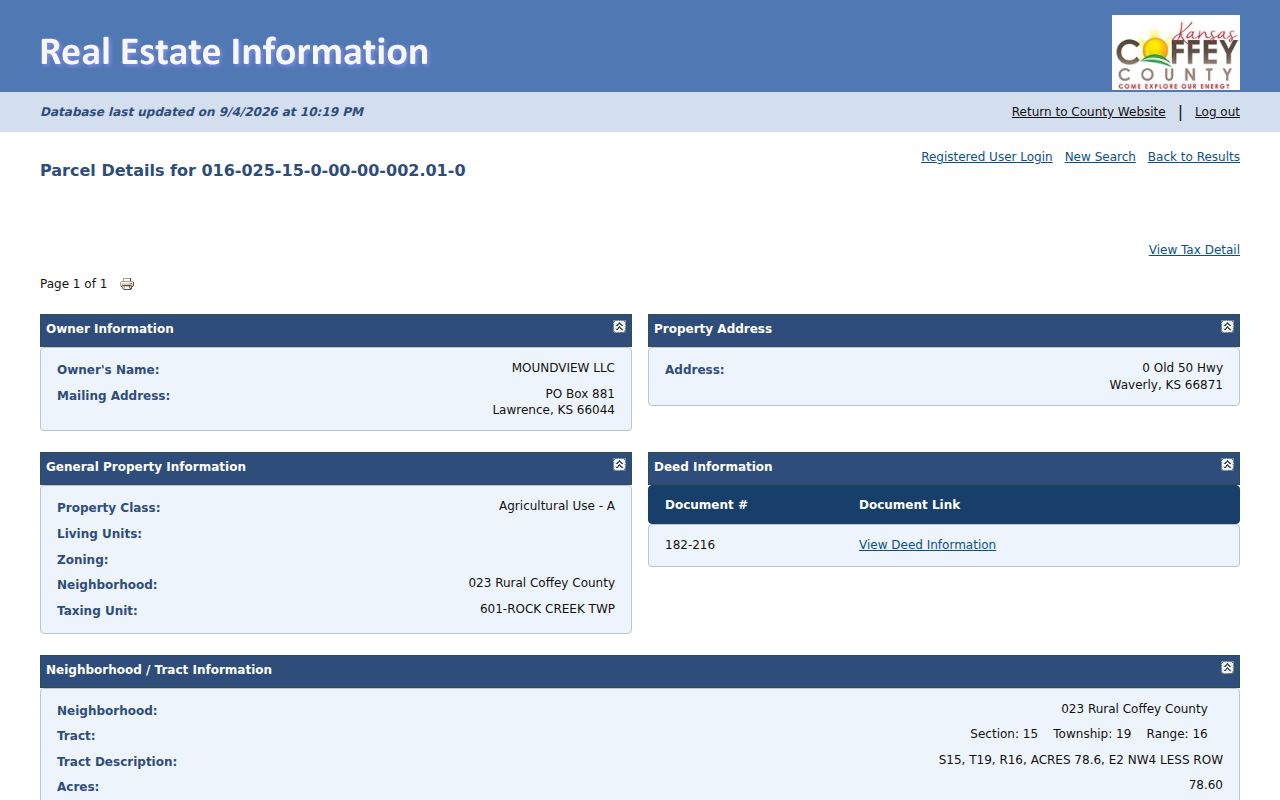
The card shows why the exact owner field matters. Save the deed reference intact before the recorder handoff, since both details anchor the confirmation step with the Register of Deeds.
Monitor Coffey Owner Names
The county Recording Notification System accepts prior names plus one business name. A separate form covers each added individual. It is a monitoring tool, not title insurance. The form warns that a missed or wrong alert does not make the county liable.
A March 2025 local warning described fake warranty and re-registration mail, so verify any demand through the official Register of Deeds phone and page. A paid solicitation is never a county recording requirement.
Limits of Coffey Owner Records
A public record can identify the owner of record. It cannot establish occupancy or certify title. Coffey County records may lag a transfer or carry a protected substitute address. Kansas Safe at Home gives eligible survivors address confidentiality and mail forwarding, so respect those privacy safeguards.
Lawful use. A Coffey County owner lookup supports property research and due diligence. Never use owner data to harass, intimidate, or harm anyone.
A dependable Coffey County answer keeps three kinds of evidence separate. The CAMA card is a public appraisal display. The deed is the recorded transfer itself. A newspaper clipping or archive item is only a historical clue. A name found at one level should never be promoted to a legal conclusion the source cannot carry.
Test the address exactly as written first. If that fails, split it into pieces: house number, direction, street name, suffix, and ZIP. CAMA also lets you query parcel segments, book and page, instrument number, ownership dates, subdivision, tax unit, and neighborhood criteria. Those alternate keys matter most for rural situs addresses that use a zero house number. They matter just as much for roads whose names have changed.
Once the right parcel opens, compare the APN, acreage, legal description, and taxing unit before copying any owner. Coffey County cards can hold long quarter-section descriptions and right-of-way exceptions. Those details separate adjoining agricultural tracts that share a road label and mailing city.
Preserve the owner string character for character. An ampersand may join co-owners. A semicolon may divide trust names. An LLC suffix can be part of the indexed identity. Broadening a search too early mixes unrelated people or entities, so search the exact name first. That gives the recorder a cleaner request and makes later variations easier to judge.
Confirming the deed is an office step here. Coffey County publishes no public grantor-grantee screen or deed-image portal, so the Register of Deeds does that work. The office sits in Room 205 at 110 S 6th Street in Burlington, and the phone number is 620-364-2423. A request works best when it supplies the APN, legal description, exact owner name, and deed reference. Add an approximate recording date too.
A parcel card's deed link or document notation is a lead, not the deed image. Ask for the newest instrument that conveyed the described tract into the displayed owner. Read the grantee, the recording date, the legal description, reservations, and referenced documents. When the grantee matches the appraisal roll, the two sources agree on the current owner. They still stop short of a certified title search.
Trust and estate ownership needs careful wording. The appraisal roll may name trustees or a trust. A probate file or real-estate death certificate explains how an interest actually moved. Court material can show an estate proceeding exists, but the operative land transfer still belongs in the recorder's records. Never assume a relative or beneficiary became the owner of record without that deed evidence.
For company ownership, the Kansas Secretary of State search can surface public entity details. It cannot substitute a member, manager, or registered agent for the grantee named on the deed. If the recorded instrument and parcel roll show a titled entity, that entity is the answer to who owns the property.
The county's separate systems do not always update at the same moment. CAMA's owner field carries a display date, yet Coffey County publishes no guaranteed closing-to-roll interval. A recently recorded deed can therefore be newer than the public owner field. That is a reason to confirm a transfer, not a reason to call either office record defective.
Recording notifications add a useful watch after an owner is identified. The county form accepts other names used and one business name, and any other person or name requires a separate form. The notice service cannot certify title, block a filing, or promise every alert arrives. Treat it as a monitoring aid alongside periodic record checks.
When the address itself stays uncertain, the county GIS route can help locate the parcel shape and number. GIS data serves tax and reference purposes only. It is not a conveyance or a boundary survey. Carry the map's parcel number back to CAMA and the recorder rather than treating a drawn line as proof of ownership.
Kansas Safe at Home may replace an eligible survivor's location with a substitute legal address. That safeguard deserves respect along with every other privacy limit. Ownership research suits purchase diligence, estate work, easement questions, deed-fraud monitoring, and property history. It never authorizes surveillance, unwanted contact, or any effort to identify occupants.