
Fields Inside Coffey County Property Tax Records
Coffey County property tax records live in two offices. The County Appraiser discovers, classifies, and values taxable and exempt property across the county. The Treasurer then bills, collects, and tracks delinquencies. Check both sides before relying on any single figure, because a valuation is easy to mistake for an amount due.
| Field | What It Shows | Where |
|---|---|---|
| Appraised or market value | The Appraiser's estimate before the statutory class ratio is applied | CAMA parcel card |
| Assessed value | The value to which local levies are applied | Appraiser record |
| Land, building, and total | Separate components that explain the overall appraisal | CAMA detail |
| Tax bill and status | Tax year, amount, payment, and delinquency information | Treasurer Tax Search |
| Taxing unit | The city, township, school, fire, and other levy geography tied to the parcel | Parcel and tax records |
A tax bill is not a sale appraisal. The two numbers answer different questions. Kansas applies assessment ratios by property class under K.S.A. 79-1439, local levies act on the assessed value, and exemptions or special agricultural treatment can push the tax figure even further from an open-market estimate.
Coffey County Appraiser and Treasurer Have Separate Jobs
The Coffey County Appraiser maintains each parcel's core details. Its records hold the property description, class, neighborhood, tax unit, acreage, and value history. Connie Lawrence's office sits at 110 S 6th Street in Burlington and answers at 620-364-8426. The office sets no rates and sends no bills.
The Treasurer owns the tax account and payment trail. The online system reaches beyond real estate. It also covers personal property, oil, gas, trucks, minerals, and state-assessed utilities, which is why you should pick the correct record type before interpreting a result.
Search Fields in the Coffey County Treasurer Portal
The Coffey County Tax Search opens several routes. A parcel number is the cleanest bridge from CAMA, while owner and address fields help when the account number is unknown.
| Search key | Best use | Detail to preserve |
|---|---|---|
| CAMA number | Matching an appraiser parcel to its tax account | All segments and leading zeroes |
| Owner or taxpayer | Finding accounts by the stored name | Entity suffixes and punctuation |
| Street and ZIP | Finding a known situs | Number, name, direction, and ZIP |
| Subdivision, block, lot | Narrowing a platted property | Recorded subdivision spelling |
| Tax year | Separating current and older obligations | The year selected |
The Treasurer's tax portal shows a database update date on its search page. That signals ongoing maintenance. It does not guarantee an immediate update. A fresh deed recording, payment, or value adjustment may lag.
The official Treasurer Tax Search lays out the search criteria you can use.
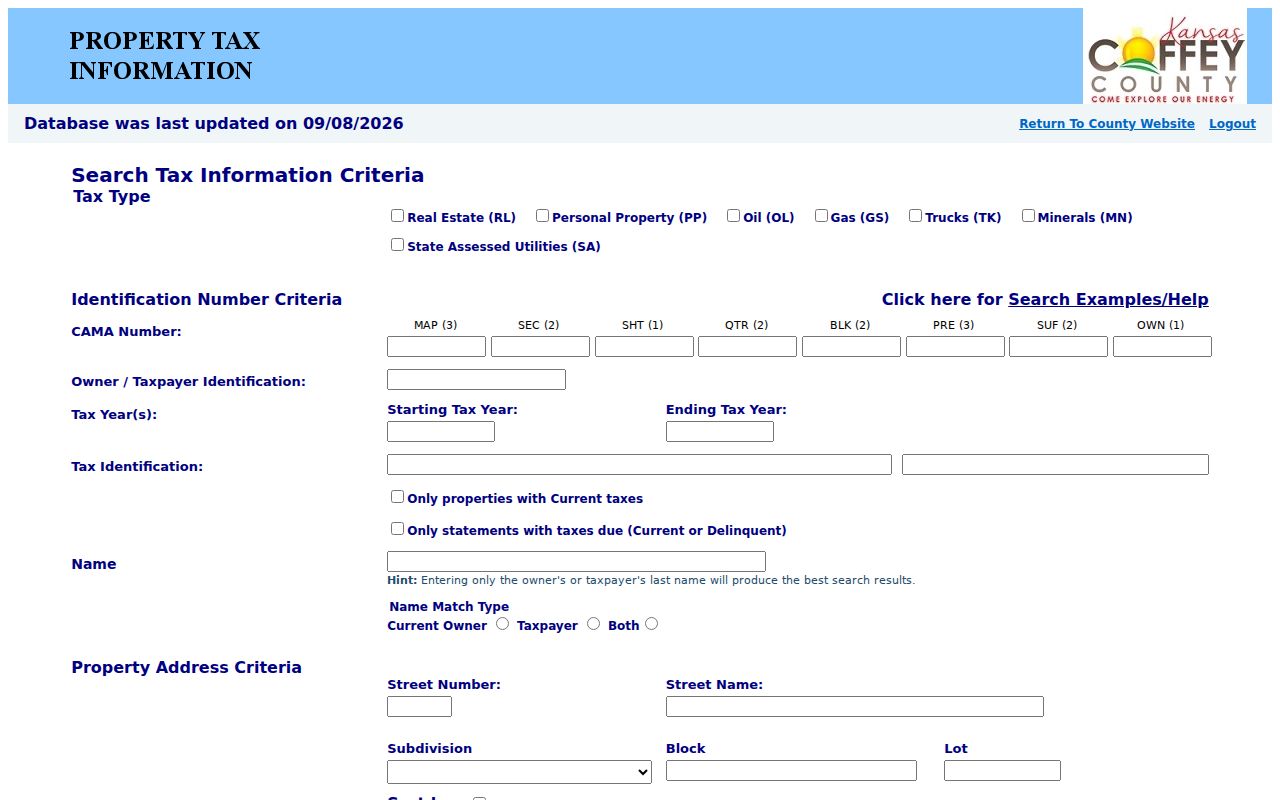
The tax search form runs separately from the CAMA appraisal data. Match a Treasurer tax account to an appraisal result by parcel number rather than assuming the two are one database.
Coffey County Land, Building, and Total Values
One rural Gridley parcel card illustrates the layout. It listed land at $8,800. It listed buildings at $292,100. The displayed 2026 total came to $300,900. The same card flagged a farm homesite and one living unit. It also carried a Liberty Township tax unit and improvement descriptions. A single parcel is never typical, but the components show exactly how the total is built.
An agricultural card revealed a sharper split. It carried an agricultural use value of $10,400 beside a market value of $227,940. Kansas agricultural land treatment can drive those numbers far apart. So always quote the label along with the figure when citing Coffey County property tax records.
Look Up a Coffey County Tax Bill Step by Step
Start with an address search to identify the property. Then work through the official sources in a fixed order, carrying the same parcel number at every step. That identifier keeps things clear when the mailing address and the situs address differ.
- Open public CAMA, locate the parcel, and copy its full segmented number.
- Enter that number in the Treasurer Tax Search and choose real estate.
- Confirm the tax year, taxpayer name, property description, amount, and payment status.
- Return to CAMA to read class, value components, and taxing unit.
- Contact the Treasurer if a past-due account is unavailable online or a payment has not posted.
- Assessed value
- The class-adjusted value used in the tax calculation.
- Mill rate or levy
- The rate imposed by the applicable taxing bodies.
- Exemption
- A statutory removal or reduction from taxation when eligibility is approved.
- Tax lien
- A claim attached after taxes remain unpaid under the county calendar.
Coffey County Property Tax Dates That Change Status
Coffey County's Treasurer mails tax statements by the end of November. From there, two deadlines matter. Pay the full amount or the first half by December 20. The second half is due by May 10 of the following year. Miss them and the account's legal status changes. So treat these dates as more than reminders.
Real-estate and utility taxes that go unpaid get advertised in the official newspaper on August 1. A $16 publication cost is added. If the balance remains after the first Tuesday in September, it becomes a lien on the parcel. A newspaper listing is only a lead. Confirm legal status through the Treasurer's account and the recorded deed and tax roll documents.
Paying and Confirming Coffey County Property Tax
The Coffey County Treasurer takes tax payments several ways. Mail, the courthouse counter, and the east-side drop box on Sixth Street all work. The Kansas Property Tax Payment route works too. Paying online calls for your statement, a card or e-check, and a KanAccess account. The fee runs $2 online plus 2.5% on cards. Counter card payments carry that same 2.5%. Give an online payment two to three business days to post. For a receipt or an account question, call 620-364-5532 during the published hours. Those hours run Monday through Friday, 8:00 a.m. to 4:30 p.m. Keep your confirmation. Then recheck the status before assuming the payment landed on the tax roll.
Kansas Ratios Shape Coffey County Assessments
Kansas law sets the assessment ratio by property class. Residential real property is generally assessed at 11.5% of appraised value. Commercial and industrial property sits at 25%. Vacant lots sit at 12%. Agricultural land works differently. A use-value system governs it, not a simple comparison of home sales. Class drives the math, so start with the CAMA classification on the parcel card. It may show residential, agricultural, commercial, not-for-profit, public utility, vacant-lot, or another category. If the category looks wrong, treat that as its own issue. Keep it separate from any dispute over the appraised amount or the tax bill itself.
Exemptions and Refund Programs in Coffey County
Coffey County owners sometimes assume an exemption applies itself. It does not. The Appraiser hands out the property-valuation exemption forms. The Kansas Department of Revenue lays out the statewide exemption categories plus homestead refund programs. What counts is the application itself. The proof attached to it matters too. So does the agency's final decision.
Residential property in Kansas gets one built-in break. The school-finance levy exemption covers the first $75,000 of appraised value. That trims the school portion of the bill only. The other local levies still stand. Read a Coffey County tax bill line by line. Then ask the Appraiser which classification or exemption the roll actually shows.
Challenge a Coffey County Assessment on Time
Watch the clock once a notice of value arrives. Kansas generally gives an owner about 30 days from the mailing date to appeal. Start with the Coffey County Appraiser. Arrive with a focused record: the parcel card, photographs, measurements, comparable sales, repair evidence, and the exact field believed to be wrong. A payment-under-protest route also exists under Kansas law, tied to the tax-payment schedule.
Protect the deadline. Use the mailing date on the notice and current Kansas appeal instructions; a portal timestamp does not extend the filing period.
Where do the forms live? The Kansas Property Valuation Division publishes the appeal framework, and Coffey County links a local tax-grievance form. A grievance, a value appeal, and a payment under protest overlap in purpose but stay distinct, so confirm the right form before filing anything.