
Coffey County Owner of Record
Start with the free Coffey County CAMA Parcel Search. The owner field there reflects the name used for current appraisal work.
Lookups run several ways. Try an address or an exact owner string. Parcel segments work too. The same goes for a legal description, a subdivision, the tax unit, or a neighborhood. Each parcel card also splits the situs from the owner's mailing address for tax notices. The situs is the physical location.
| Owner's Name | Person, trust, or entity string carried on the appraisal roll |
|---|---|
| Mailing Address | Destination used for owner correspondence and notices |
| Situs Address | Physical location assigned to the parcel, when one exists |
| Parcel and Legal | APN and tract language that identify the land |
| Deed Reference | Document or book/page lead for recorder confirmation |
| Record Context | Classification, neighborhood, tax unit, acreage, and values |
An owner of record is not always an occupant. Coffey cards list LLCs, trusts, out-of-county mailing addresses, and rural zero-address sites without comment. Copy each field exactly as written, and use the public mailing address for any lawful contact.
Separate Coffey Owner, Mail, and Situs
These three values can point to three different places. The mailing address tells you where notices go. The situs identifies the land itself. Neither one proves who lives there. One trust parcel carries a Gridley situs with a Leawood mailing address, and an LLC parcel near Waverly gets its mail in Lawrence.
That split is normal record structure, not an error. Rural tracts sometimes carry a zero-number situs such as "0 Old 50 Hwy." When an address search stalls, save the segmented APN and the legal description before chasing the current owner.
Note: A city ZIP can coexist with a township tax unit, so neither field alone proves jurisdiction or ownership.
Read Coffey Entity Owners Exactly
CAMA will place a company or trust straight into the owner field. Example entries include MOUNDVIEW LLC and a combined trust naming Teresa E. Reicherter and Ryan W. Crawford. Search the exact indexed string first. Punctuation can change the result. Trustee wording can change it too. So can an entity suffix.
The Kansas Business Entity Search adds public filing context for an LLC. It is no substitute for the deed. A registered business contact is not automatically the titled owner in a personal capacity.
Inspect a Coffey Current-Owner Card
A sample CAMA parcel card puts owner, mailing address, situs, APN, legal description, deed references, and value fields on a single record.
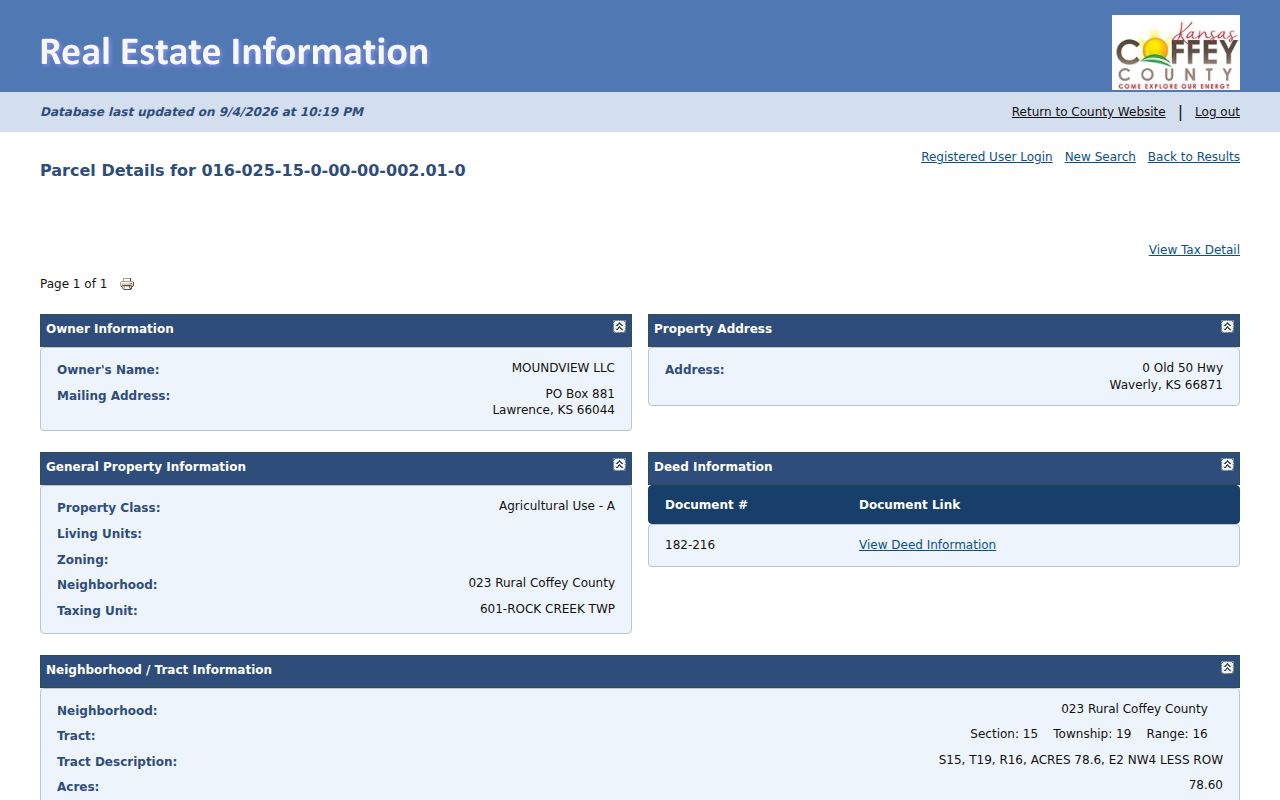
That single-screen layout shows why an owner's name should travel with its parcel key. The deed reference on the card then becomes a focused lead for the recorder's office.
Confirm Coffey County Ownership Now
The appraisal roll is the best current search lead. The newest recorded deed is the transfer record. The Register of Deeds publishes no public grantor-grantee portal, so confirming ownership takes an office visit, a phone call, mail, or a focused written request.
- Copy the CAMA Owner's Name, APN, legal description, and deed reference.
- Ask the Register of Deeds for the newest deed affecting that tract.
- Compare the deed's grantee with the current roll string and recording date.
- Keep an entity name intact while checking its public state filing context.
- Owner of record
- The party named on the current appraisal record.
- Situs
- The location assigned to the land, distinct from owner mail.
- Recording lag
- The gap between a transfer and its appearance in another county system.
Measure the Coffey Roll's Freshness
The portal displays a database timestamp, and each parcel card carries its own record-updated notice. Those signals point to an active refresh cycle. They do not promise that every recent transfer has posted. Coffey County publishes no fixed closing-to-roll interval.
The Register of Deeds records the deed itself. The county offers no public grantor-grantee screen or deed-image portal. Confirmation therefore means an office request built around the CAMA identifiers.
Recent-sale gap. The appraisal roll can lag a closing. The newest recorded deed is the more current transfer record, though neither source is a title opinion.
Use Coffey Deed References as Leads
CAMA can list several deed document references on one card. The trust parcel referenced above shows 187-155, 178-62, and 177-656; an agricultural example lists 185-013 and 181-226. Treat these as request clues. The appraisal portal does not serve public deed images.
Give the recorder the displayed reference, the exact owner string, the APN, and the legal description. That package beats a common surname by a mile, and it lets staff zero in on the latest instrument for the parcel.
Coffey Recording Alerts Watch Names
The county Recording Notification System accepts prior names plus one business name. A separate form is required for each additional name. It can alert a subscriber when a later recording is indexed under that string. It is not title insurance. Its form disclaims liability for missed or erroneous notices.
A March 2025 county warning also flagged fake warranty-deed and re-registration mail. Confirm any payment demand through the official recorder page or the office phone, 620-364-2423.
Reach a Coffey County Owner
Use the public mailing address on the roll for a lawful property inquiry. Never assume the owner lives at the situs. Kansas Safe at Home gives eligible survivors a substitute legal address with mail forwarding, and public-record access never licenses harassment.
Lawful use. Public owner data supports legitimate property diligence. Never use it to watch, harass, intimidate, or harm anyone, and respect protected substitute addresses.
Start any Coffey County current-owner lookup by confirming the parcel card describes the right land. Check the situs, parcel number, acreage, legal description, neighborhood, and tax unit against one another. Rural roads make this essential. Several tracts can share a mailing city, and a zero house number marks no unique entrance.
The public CAMA form offers many search fields. Owner name, full address, street pieces, ZIP, parcel segments, legal description, book and page, instrument number, ownership dates, subdivision, tax unit, and neighborhood are all available. When one route turns ambiguous, try a second field instead of settling for the first similar result.
The current owner is whoever appears now on the appraisal record, whether a person, trust, or entity. That label does not extend to the occupant. It does not cover every historic taxpayer. It also does not reach whoever signed a private contract recently. Keep conclusions narrow and cite the source. When the roll and a recent closing disagree, the current deed is the stronger transfer evidence.
At the recorder, request the most recent deed into the displayed grantee. Do not request every document under a common surname. Bring the CAMA document reference if you have one. The Coffey County office also records mortgages, assignments, releases, liens, easements, plats, surveys, powers of attorney, and real-estate death certificates. Related instruments may explain odd vesting.
Trust owners often appear with trustee names, and entities may list mailing addresses outside Coffey County. Neither detail makes the card stale. Search the exact indexed string first. Then use the legal description and the newest deed to confirm the entry belongs to the parcel. A Kansas business filing can clarify an entity's public status, but it cannot rewrite the grantee.
Recording dates and appraisal refresh dates answer different questions. The deed records when an instrument entered the public land records. The portal timestamp records when a database was refreshed. The county publishes no fixed synchronization promise. A careful report states both dates and avoids claiming a precise lag.
Probate can explain a mismatch. When an estate proceeding is involved, the current roll may name a different person than an older deed. Follow the court clue back to the recorded estate deed, death certificate, or other operative land instrument. Heirship should never be guessed from a surname, obituary, or family relationship.
Note: A public mailing address can support a concise, lawful property inquiry, but it is not proof of residence. Kansas Safe at Home gives eligible survivors substitute addresses and mail forwarding. A responsible Coffey County property search leaves that protection intact.